The context
FIM Srl is a historic name in Made-in-Italy manufacturing: over a century of professional umbrellas and outdoor solutions, for the contract world (hotels, restaurants, Ho.Re.Ca.) and high-end residential. A company that sells made-to-measure products worldwide, where every umbrella is a combination of collection, structure, size, fabric and finish.
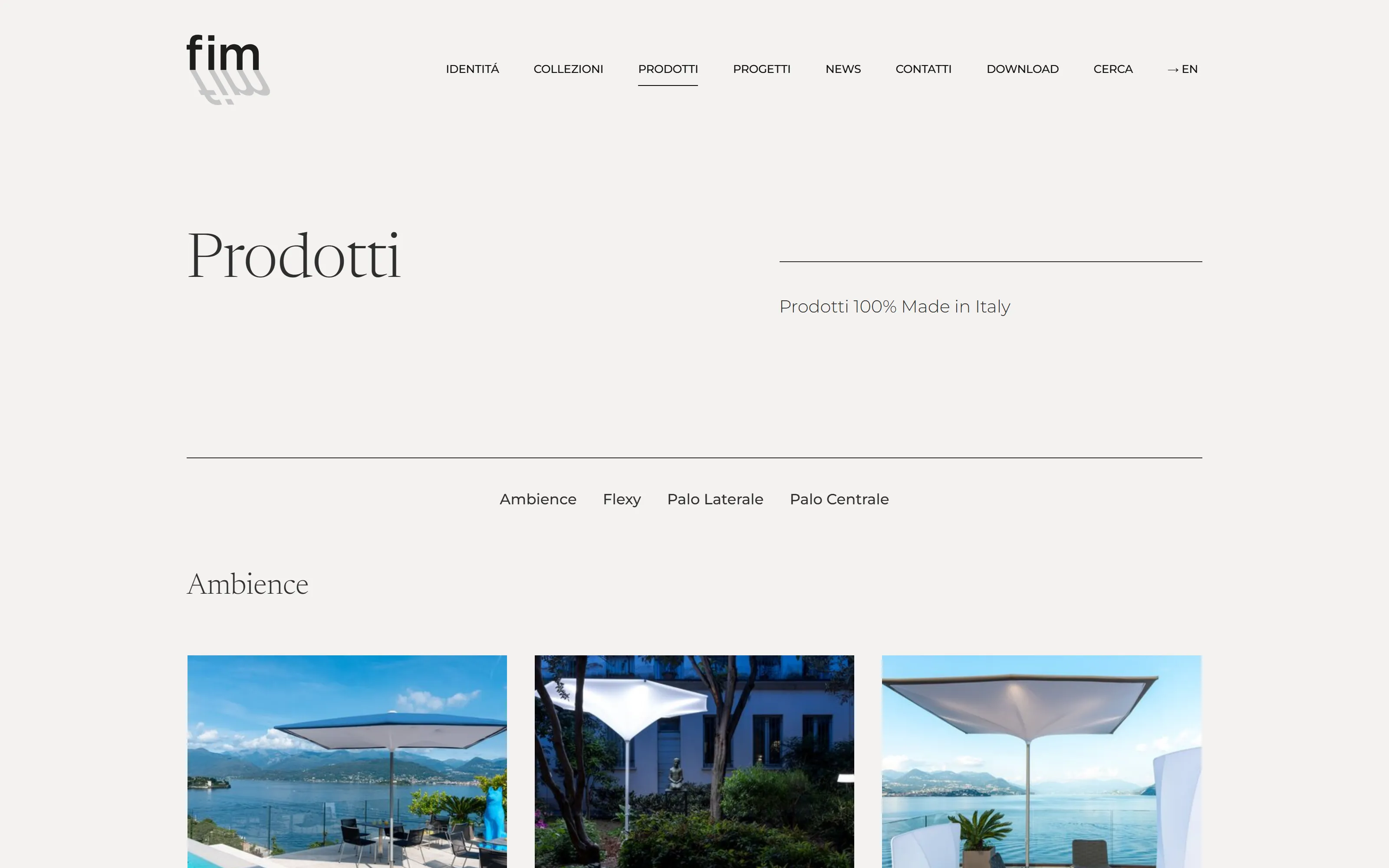
That catalogue richness is its asset, and its problem. Hundreds of models across dozens of collections (Ambience, Flexy, Palo Centrale, Palo Laterale and more) generate hundreds of thousands of variants, whose product information lived scattered across departments, files and price lists. Hard to govern, almost impossible to bring online as it was.
The challenge
Bring order to that asset and make it usable: it needed a PIM (a product information management system) able to handle thousands of variants, and a new website to present them, both fed by a coherent set of 3D/CAD models. The risk was that catalogue complexity would become chaos instead of a sales tool.
The solution
The project was born in collaboration with the agency Extera, which handled development and programming. XKDIGITAL’s role was the direction: the organisation and architecture of the data (how product information had to be structured, the catalogue logic, the site choices) and the generation of over 300,000 CAD models to feed the PIM and the 3D visualisation. A volume impossible by hand: it is CAD automation at scale.
In short: Extera built the machine, XKDIGITAL defined how it had to be made and filled it with structured data. It is the role we do best: standing between the company and the developers, translating a complex catalogue into a structure that developers and salespeople can actually use.
This work also produced the 3D configurator based on FIM’s Autodesk Inventor models: the same CAD asset that feeds the PIM becomes an interactive tool. You’ll find it below: it’s FIM’s real umbrella, to rotate and configure in the browser.
The results
Over 300,000 CAD models generated and organised, a PIM structured from scratch and a coherent product website: the most complex catalogue becomes governable, and product data stops living in people’s heads to become a system. When data direction and development work together (each in its own craft), complexity turns into an advantage.